
PM has developed its own tools and methods, including the Resilience Decision Support Tool, to measure and make the resilience of an organization discussable.
PM not only provides advice on crisis management and business continuity management but also helps organizations become more resilient. Resilient companies are able not only to absorb shocks but also to turn them into opportunities, thereby gaining a competitive advantage.
What’s in a name?
Never before has there been so much talk, research, and writing about “resilience” as in recent years. We use the word in our daily communication; scientists study the phenomenon, politicians consider it important, and large institutions such as the World Health Organization (WHO) and the European Commission regularly discuss the topic with international experts. Many companies have also recently started to focus intensively on resilience. Resilience is a popular concept, but for many organizations, it remains vague: what does it mean, and how can it be developed?
We ourselves have become fascinated over the past years by what resilience truly means, which elements are involved, and how you can make an organization’s resilience level visible. Our research showed that resilience is not about ticking boxes but about what you do and how you align this at the executive level. We developed a tool that visualizes directors’ perception of their resilience (the Resilience Decision Support Tool), a methodology to discuss the results, and a holistic approach to analyze and strengthen the crucial processes within the organization. Ultimately, it’s about being more resilient today than yesterday.

The Decathlon Analogy
Organizational resilience can be compared to the decathlon, an Olympic discipline in which athletes compete in ten athletic events over two days: four running events, three throwing events, and three jumping events.
An athlete’s final score is the sum of the scores from each individual event. This means you cannot train for the decathlon as a whole; you can only train for the individual events. And even if you perform below par in one event, you can still win the decathlon. The comparison to resilience is easy to make: organizations cannot build resilience as a whole, but they can develop capabilities within the different domains that together form resilience. Ultimately, resilience is a strategic choice, and it is up to organizations to decide where to invest or where to consciously choose not to invest (this is known as being “competently incompetent”).
Moreover, the decathlon requires excellent physical and mental condition to handle the rapid succession of events, just as organizations must be in shape to be able to manage multiple tracks that ultimately lead to resilience.
In the case of organizational resilience, fortunately, there is little running, jumping, or throwing. Instead, it is about strengthening capabilities in the so-called anticipation, coping, and adaptation phases, each involving cognitive and behavioral actions and resources. Before organizations can make decisions to enhance their capabilities, it is advisable to assess their current status. For this, our Resilience Decision Support Tool is ideally suited. Measuring is knowing.
Organizations that seek PM’s advice on resilience are often also interested in business continuity management.
Working method

Let us get in touch
Strategically building resilience? Leave your details here, and we will get in touch as soon as possible.
Relevante updates

A week at Alder in London: a different perspective on crisis communications
As part of the CCNE exchange programme, I spent a week at Alder, our UK-based CCNE partner agency in London.…


European Crisis Experts: Cyberattacks Remain the Top Business Risk, While AI Introduces New Challenges
What are the biggest crisis risks facing European organisations today? The latest CCNE Pulse Check, the annual survey conducted by…

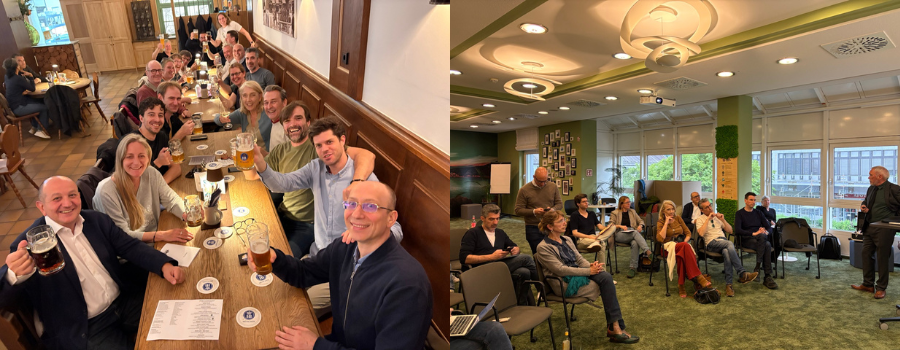
What Do Risk Management, Crisis Communication and Resilience Really Have in Common?
From 3 to 5 June, experts in resilience management, risk management, business continuity, crisis management and crisis communication gathered in…