
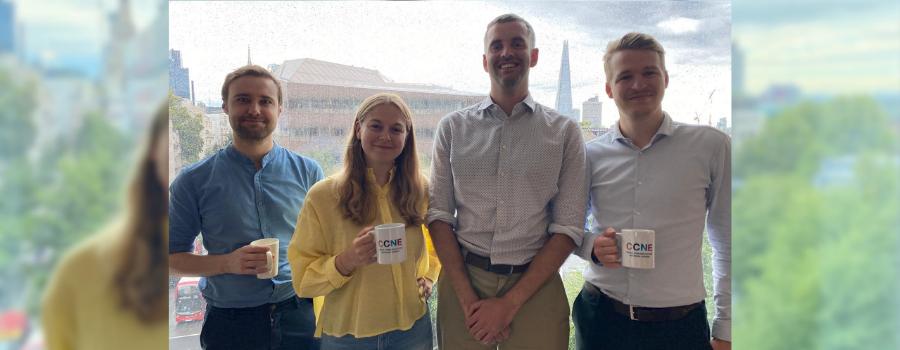
As part of the CCNE exchange programme, I spent a week at Alder, our UK-based CCNE partner agency in London. Together with Felix from Engel & Zimmerman in Germany, I joined the team for the week: sitting in on meetings, working together on live crisis cases, exploring scenarios and constantly comparing how crisis communications is approached in Belgium, Germany and the UK.
The exchange was particularly interesting because we brought three different perspectives to the same cases. Felix and I worked together on a number of cases that Alder had dealt with in the past. Based on our own experience, we developed a crisis communications strategy and then presented our approach to the Alder team. The discussions that followed often led to some surprising insights. An approach that seems perfectly logical from a Belgian or German perspective can suddenly need to be completely rethought in the UK because of differences in legislation, culture or media practices.
And that is exactly what makes the CCNE network so valuable. Working with colleagues from different countries allows us to constantly compare approaches and learn from one another. We looked, for example, at the differences between the British, Belgian and German media landscapes, journalists’ codes of ethics and how these are applied in practice. These differences have a direct impact on the advice we give our clients as crisis communications consultants. The Flemish code is the most detailed and stringent in day-to-day practice, the German code provides the broadest ethical framework, while the UK code has the strongest enforcement powers on paper.
How Belgium, Germany and the UK differ
My impression after this week is that Alder’s clients tend to be slightly more influenced by journalists and the media than the clients we work with at PM. Media attention seems to play a more prominent role in some of their strategic decisions. Not necessarily better or worse, but simply different. And that nuance is important when working as a crisis communications adviser in a different context.
For example, in the UK, there can be consequences for a company that communicates about an arrest involving the company or one of its employees. In most criminal cases, communication only takes place once a formal charge has been brought. In Belgium, we also need to be careful about communicating when a judicial investigation is ongoing, but in principle there is more scope to communicate about an arrest involving your company or one of your employees. As long as you are protecting your own interests without interfering with the judicial investigation, there is more room to communicate.
Alder’s client portfolio also differs from PM’s. Alder mainly works with charities and foundations, schools and healthcare organisations. At PM, our work is broader, covering sectors including industry and chemicals, healthcare, government and critical infrastructure. Naturally, this is also reflected in the types of cases we deal with. At Alder, the focus is more often on strategic issues, such as scandals and reputational challenges. At PM, these types of cases are also part of our work, but we additionally deal with physical incidents, such as fires.
Many of Alder’s cases also come through lawyers, making them important stakeholders with whom to maintain strong relationships. At PM, we certainly work with lawyers too, but this tends to happen more occasionally.
The way the work is divided also stood out to me. At Alder, around 85% of their time is spent on acute cases and 15% on training. At PM, the balance is almost the opposite: around 80% of our time goes towards training and consultancy, with 20% dedicated to acute crisis communications. Alder also often works on planned ‘long shots’, whereas the acute cases we deal with at PM tend to come in more ad hoc and are often short but intense.
A different context, the same fundamentals
Yet there are also many similarities. Ultimately, we work from the same crisis communications principles: identify your stakeholders and what really matters to them, avoid making the situation worse, and know where you want to go and how you are going to get there.
I am very grateful to have had the opportunity to spend this week at Alder, broaden my perspective on crisis communications and, at the same time, discover a little more of this vibrant city.
A huge thank you to the whole Alder team for the warm welcome, the interesting cases and the great conversations!
